




 Nicolas Borenstein
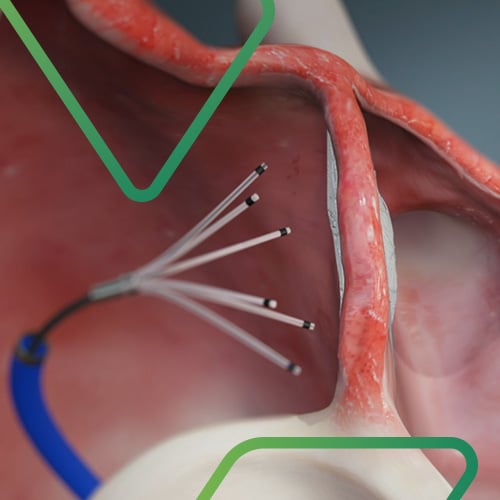
Patent foramen ovale (PFO) affects roughly one in four adults and is a recognized cause of stroke in younger patients, particularly those with cryptogenic stroke. Current occluder devices have been transformative in reducing stroke recurrence, but they require extended antithrombotic therapy and antibiotic prophylaxis, sometimes beyond six months for larger devices, due to incomplete endothelialization. Studies show that insufficient device coverage months post-implantation remains a persistent challenge with existing designs, and larger device profiles have been identified as risk factors for atrial fibrillation and atrioventricular block.
Recross Cardio's PFO Sealing Technology represents a fundamentally different approach: a lightweight nitinol frame covered with a thin polymer membrane that achieves a 3x reduction in material bulk and a substantial reduction in size compared to existing occluders. The membrane is designed to accurately conform to the patient’s anatomy to reliably seal the PFO while preserving the ability to "recross" the septum if future interventions are needed. The goal: Excellent sealing at index procedure, rapid in-situ endothelialization to potentially reduce the need for long-term antiplatelet and antibiotic treatment and a dramatic reduction in implanted material to better protect surrounding cardiac structures and functions. For patients, this means stroke prevention without permanently closing the door on future treatment options and potentially shorter durations of the dual antiplatelet therapy that commonly causes bruising, bleeding, and gastrointestinal complications.
 “For Recross, the preclinical work wasn't just about completing the required studies. It was about generating evidence strong enough to support FDA's decision to grant EFS approval and building the foundation for eventual commercialization." - Tom Gerhardt, CEO and co-founder of Recross Cardio
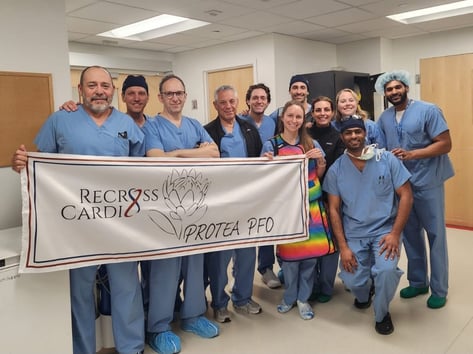
On December 3, 2025, Recross Cardio announced the first patient enrolled in its PROTEA-PFO Early Feasibility Study (EFS), a prospective, multi-center trial that will enroll up to 15 patients at five U.S. centers of excellence. The procedure was successfully performed by Dr. Carey Kimmelstiel and his interventional team at Tufts Medical Center in Boston.
That milestone didn't happen by accident. It required two successful GLP preclinical studies that generated the safety and performance evidence FDA required before granting approval for first-in-human trials. (Image right: "First case" team. Courtesy, Recross Cardio).
The Regulatory Bridge: Why Preclinical Evidence Had to Be Clean
Regulatory bodies require comprehensive safety and performance data before human trials can begin. For medical devices, particularly cardiovascular implants, that evidence comes from Good Laboratory Practice (GLP) studies conducted in appropriate animal models. These aren't pilot studies or feasibility tests; they're the formal safety assessments that regulatory reviewers scrutinize to determine whether human trials are justified.
When GLP studies are poorly designed or incompletely executed, they create questions that ripple through regulatory timelines. A single unresolved observation can trigger additional studies, delaying first-in-human trials by months or even years. For Recross, the stakes were clear: the preclinical work had to generate data clean enough to satisfy reviewers on the first submission.
That required more than just technical execution. It demanded strategic thinking about model selection, surgical precision, and an understanding of what regulators actually need to see.
The Anatomical Challenge: Excellence In Translational Science Finds the Sweet Spot
 Developing a PFO sealing device for human anatomy presents a specific preclinical challenge: finding an animal model that balances anatomical fidelity with procedural feasibility. Our animals have atria that are not large compared to humans. They're maybe not even half the size. (Image right: author Nicolas Borenstein, DVM, PhD)
For a device designed to seal atrial defects with specific dimensional requirements, undersized atria create immediate problems. The device may not deploy properly, or anatomical constraints may force procedural modifications that don't reflect clinical reality. The obvious solution - moving to larger animals - introduces a different problem: If you go to larger animals then they're very long, and if they're long then your catheter might be too short for the anatomy from puncture site to fossa ovalis and trans-septal.
This is where model selection becomes strategic science rather than commodity service. As I wrote in a recent analysis of preclinical model determination, the goal isn't finding an anatomically "close enough" model; it's identifying the minimum viable model that provides the specific evidence regulators need while maintaining procedural fidelity to human workflows.
For Recross, that meant Veranex's team had to find the sweet spot, and we did. The solution wasn't obvious from the literature. It required understanding both the device's specific dimensional requirements and the comparative anatomy across multiple porcine and ovine options, then designing surgical approaches that replicated human transseptal catheterization without introducing artifacts that would confound the data.
This is translational science in practice. It's not copy-and-paste from human procedures to animal models. It's creative adaptation that acknowledges the limitations of models while designing studies that generate the precise evidence your submission needs. Regulators understand that perfect anatomical equivalence doesn't exist; what they need is transparent justification for why the chosen model provides valid safety and performance insights.
GLP Execution: Comprehensive Safety and Performance Assessment
The two GLP studies assessed Recross' Sealing Technology’s safety and performance at predetermined timepoints (28 days and 90 days post-implantation) across eight healthy domestic porcine subjects. The studies evaluated implantation success, device-related adverse events including migration and cardiac function, and comprehensive biocompatibility assessments aligned with ISO 10993 standards for local effects, systemic toxicity, hemocompatibility, and thrombogenicity. Performance endpoints focused on PFO closure effectiveness.
Veranex's scope extended across the full study lifecycle: housing and care of study animals, providing operating rooms and surgical instrumentation, preparing and implanting test articles in collaboration with Recross' qualified physicians, executing all protocol-specified examinations and analyses, performing gross necropsy and macroscopic assessments, conducting histopathological evaluations, and delivering the comprehensive final reports that formed the foundation for regulatory submissions.
Partnership Through the Challenges
We share very closely our disappointment and our successes or celebrations with our sponsor and client partners. We don't just serve good dishes in a nice restaurant. We are genuinely enthusiastic about innovation and very much feel a part of the adventure they're living because we are part of it.
That partnership matters most when challenges emerge during GLP studies; when an animal's physiology doesn't cooperate, when a device behaves unexpectedly, or when real-time decisions determine whether a study succeeds or requires costly repeat work. In those moments, having veterinary surgeons who understand both the regulatory requirements and the commercial stakes becomes the difference between regulatory confidence and regulatory questions.
“For Recross, the preclinical work wasn't just about completing the required studies. It was about generating evidence strong enough to support FDA's decision to grant EFS approval and about building the foundation for eventual commercialization,” Tom Gerhardt, CEO and co-founder of Recross Cardio told us.
The Result: Clean Data, Clear Path Forward, FDA EFS Approval
The outcome speaks for itself: the GLP preclinical data supported FDA approval for the PROTEA-PFO Early Feasibility Study. On December 3, 2025, Recross announced the first patient received the Recross PFO Seal at Tufts Medical Center.
Dr. Carey Kimmelstiel, Director of Interventional Cardiology at Tufts and National Co-Principal Investigator of the study, commented on the first implantation: "Delivery was intuitive, and I expect implantation times to be comparable to current devices. The conformable membrane design allows for a low profile that delivered excellent acute sealing."
For patients with PFO, this represents a meaningful step forward: a closure option that may provide stroke prevention with potentially reduced long-term medication requirements without permanently limiting future treatment possibilities. For Recross Cardio, it validates years of development work and positions the technology for the clinical evidence generation that will determine its commercial future.
And for the preclinical teams who helped make this milestone possible, it's another reminder of why this work matters. This is what gets us up in the morning. It's not just another job. It's a special endeavor.
The PROTEA-PFO EFS is actively enrolling patients at five U.S. centers of excellence, evaluating the safety and performance of the Recross PFO Seal for transcatheter PFO sealing to reduce the risk of recurrent ischemic stroke.
We are proud of the collective team’s work and will watch Recross’ continuing journey with great interest.
About the author: Nicolas Borenstein, DVM, PhD, is Co-President of Preclinical Contract Research Services at Veranex. He has led cardiovascular preclinical research at the Paris facility for more than 25 years and is a widely published author and peer-reviewed journal contributor in surgical and transcatheter preclinical science.

Regulatory bodies require safety and performance evidence before human trials can begin, but poorly designed preclinical studies don't just create delays - they waste the lives of animals and the hopes of patients waiting for better options. Veranex Preclinical Services approaches this responsibility with the intensity it deserves.
We deliver GLP and non-GLP studies across 11 therapeutic areas, with particular depth in cardiovascular technologies including TAVR and structural heart, where we set the industry standard. Our teams don't just execute protocols; they understand that translational science isn't copy-and-paste. Models have limitations, regulators know this, and our job is to design studies that generate the specific evidence your submission needs while respecting both the animals in our care and the patients waiting for your innovation.
Upstream, we can work with product development teams to ensure device readiness. Our integrated pathology services deliver insights on model optimization that improves interpretation and analysis without handoff delays, and our Regulatory Affairs teams use these findings to shape pre-sub meetings, regulatory submissions and trial designs. Downstream, our Clinical Research teams design first-in-human and pivotal trials informed by preclinical findings, while Commercial Strategy & Market Access ensures the evidence we generate aligns with payer requirements and reimbursement realities from the earliest stages. With over 100 regulatory submissions returned with no questions asked from preclinical data, we deliver evidence that clears the path to human trials and builds toward revenue.
If you're evaluating preclinical partners especially for cardiovascular or structural heart devices, or if you're navigating the path from prototype to GLP studies, contact Veranex Preclinical Services to learn how our teams can accelerate your regulatory pathway.